Kidney disease cases are on the rise. Can Singapore's healthcare system cope?
As existing resources are continually stretched thinner and thinner, experts and dialysis providers say it is crucial for Singapore to explore more preventive screening and home-based alternatives like peritoneal dialysis.
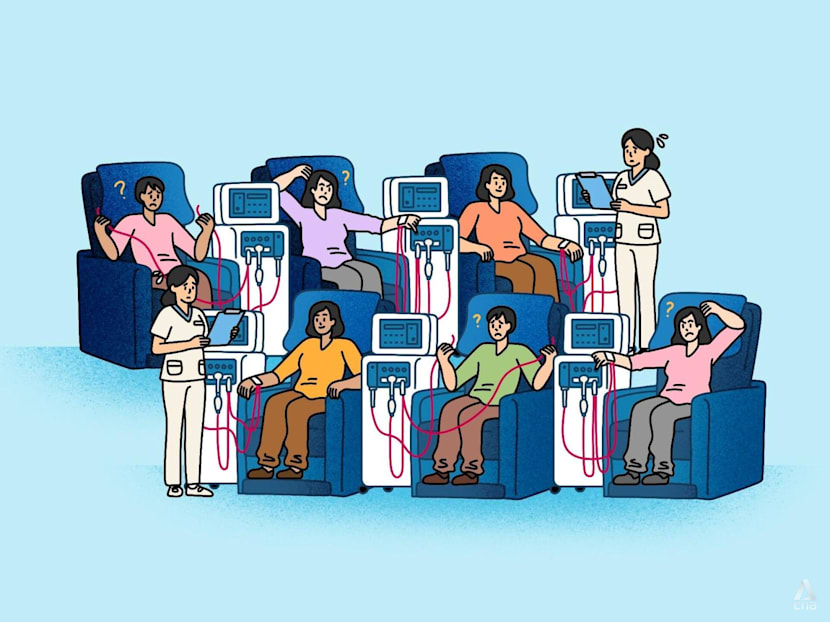
Projections suggest that by 2035, one in four Singaporeans could be living with chronic kidney disease. (Illustration: Â鶹/Nurjannah Suhaimi)

This audio is generated by an AI tool.


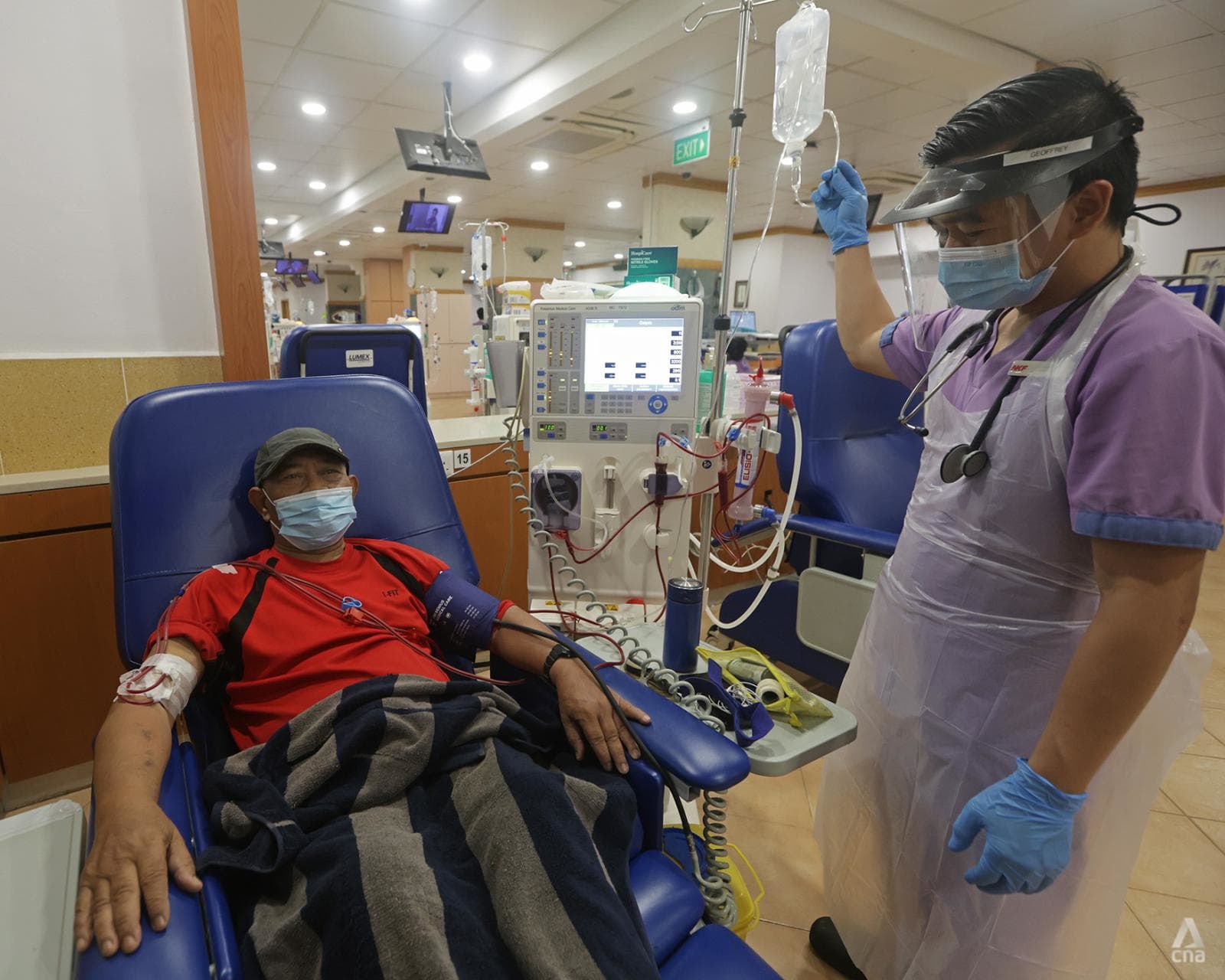
As the afternoon session begins at a National Kidney Foundation (NKF) dialysis centre in Ang Mo Kio, Mr Amer Mohamed, 68, sets up his own dialysis machine while nurses move hurriedly around him to get the room ready for other patients.
Mr Amer has been undergoing dialysis for about 13 years, attending four-hour sessions thrice a week. In the past six months however he has begun setting up his own haemodialysis (HD) machine at the start of each session.
He recalled it being "very difficult" at the start; it took him about three months to familiarise himself with the process.
"I really almost gave up. There's a lot of things (to set up)."
Although he now handles most of the steps independently including attaching tubes and a dialysate bag to the machine, nurses ensure the procedure is done accurately.
Across NKF's 45 dialysis centres, which serve patients 16 hours a day except on Sundays, Mr Amer is part of a push to help the centres cope with the rising demand that has stretched their resources thin.
He is one of 274 patients deemed competent to manage certain procedures independently under a self-care management programme, which frees nurses up so that they can focus on those with more complex needs.
Patients like Mr Amer require haemodialysis because their kidneys have failed and can no longer remove harmful waste and toxins which can cause permanent damage to cells, tissues and organs.
The treatment cleanses the blood of toxins, excess salt and fluids, and is necessary if a kidney transplant is unavailable. The Ministry of Health (MOH) national waiting list had 397 people looking for a kidney transplant as of June last year, while the average wait time in 2023 was about nine years.
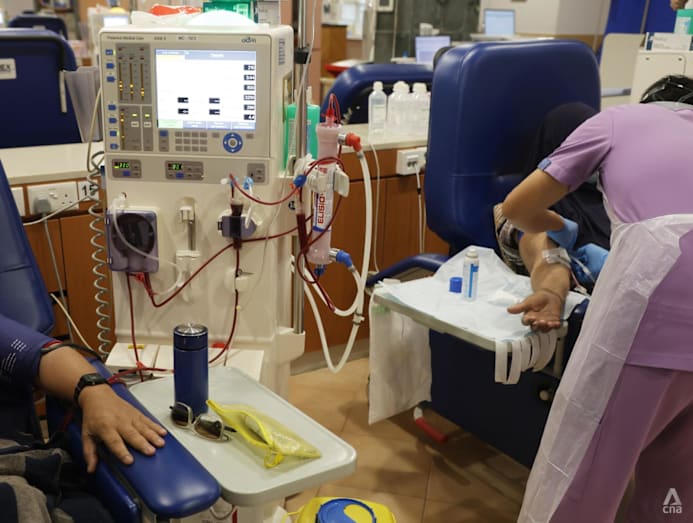
Kidney failure patients sit or lie down next to a dialysis machine while two large needles are inserted into one arm – with one needle used to remove unfiltered blood and the other to return filtered blood to the body.
Six new patients are subjected to this every day, according to statistics from the NKF – three times the rate from 20 years ago.
THE ECONOMIC BURDEN
With kidney failure becoming increasingly common in Singapore, the Republic now ranks fourth in the world for prevalence – or the number of existing cases – of kidney failure.
Projections also suggest that by 2035, .
The rise stands out compared with other major chronic conditions.
The National Population Health Survey (NPHS) 2024 by the MOH and Health Promotion Board (HPB) reported that while the prevalence of diabetes, hypertension, and high blood cholesterol here have remained stable or even declined, chronic kidney disease prevalence jumped from 8.7 per cent in 2019-2020 to 14.9 per cent in 2023-2024.
This sharp increase is likely due to more blood and urine tests resuming after the COVID-19 pandemic as well as public health agencies pushing for early chronic kidney disease screening among high-risk patients, said Adjunct Associate Professor Dr Chua Horng Ruey, head of division of nephrology at the National University Hospital (NUH).
Today, Singapore has more than 9,000 dialysis patients, around 60 per cent of whom receive subsidised care through NKF.
The overall rising cost of kidney dialysis was as a serious challenge.
Kidney disease poses a significant economic burden with over S$330 million (US$255 million) being spent annually on dialysis treatment nationwide.
Dialysis in Singapore is also heavily subsidised for low-income patients. According to the Renal Registry Report 2023 by an office in the HPB, 65.8 per cent of patients in Singapore are receiving dialysis through voluntary welfare organisations such as NKF, 32.5 per cent through private centres, the remaining 1.6 per cent through public hospitals and affiliated dialysis centres.
Heavy subsidies mean that nine in 10 subsidised patients requiring dialysis pay no cash out of pocket, said MOH.
At NKF, patients pay no more than S$50 a month, with four in 10 paying nothing at all out of pocket.
With more Singaporeans requiring dialysis and each case becoming more complex, NKF's costs have risen almost threefold from S$67.6 million in FY2014/15 to S$180 million in FY2024/25.
In FY2023, for example, it spent around S$143 million to support over 5,500 patients with over 40 per cent covered by government subsidies, while another 20 per cent came from charitable donations.
Around 30 per cent of the expense was covered by patients' MediShield Life and MediSave, while the last 10 per cent was paid largely out-of-pocket by patients.
But with operating costs and patient numbers continuing to rise, Mr Ong in April cautioned that charity dollars will not keep pace indefinitely, and without further measures, patients may eventually face higher costs.
Other subsidised providers have also flagged sustainability concerns, with Kidney Dialysis Foundation (KDF) and Ihsan Kidney Care (IKC) stating that rising kidney failure rates demand steady and long-term funding to sustain care for lower-income patients.
WHY THE SURGE?
The rising prevalence of kidney disease here is a result of the disease's intrinsic link to Singapore's most common chronic conditions like diabetes, hypertension, and cardiovascular disease.
Singapore ranks third globally for diabetes-induced kidney failure and about two-thirds of NKF patients developed kidney failure due to diabetes.
has further expanded the pool of individuals vulnerable to chronic kidney disease.
One encouraging sign, however, is that diabetes-related kidney failure among new dialysis patients has fallen from around 68 per cent in 2019 to 63 per cent last year.
This improvement, though marginal, suggests national efforts like the Beat Diabetes campaign may be beginning to make an impact, said NKF's chief executive officer Yen Tan, who took the helm in February this year.
Ms Tan said that beyond these medical drivers, the lifestyles of Singapore residents are also fuelling the rise of this disease.
Many Singaporeans consume diets high in sodium from added table salt, sauces or through processed foods, and many also often eat out – where hidden salt and sugar content as well as larger portions are common.
Such diets raise blood pressure and strain the kidneys, while excess calories contribute to obesity, a known risk factor for diabetes and hypertension. The risks are compounded when these poor diets are layered with a sedentary lifestyle.

Dr Chua from NUH said that clinicians are now seeing a rising body mass index (BMI) above the normal range of 18.5 to 22.9 among younger Singapore residents aged 30 to 39 years old and that a found a high BMI to be a significant contributor to future kidney failure.
To make matters worse, said experts, there's a lack of awareness about kidney disease leading to late detection. With early-stage chronic kidney disease largely being "silent" – or with few obvious symptoms – many discover it only when their kidneys are already significantly impaired.
The gaps in awareness and late detection unfortunately hit lower-income families hardest as they find themselves battling kidney disease earlier in life and at a more advanced stage, said IKC, which provides subsidised dialysis for these patients.
"Diet quality is a major factor, where affordable food options are often highly processed, high in sodium, and detrimental to kidney health. Limited health literacy regarding restrictions after diagnoses lead to further issues with treatment compliance," said Dr Abdul Qader Al-aidaroos, CEO of the Muslimin Trust Fund Association which funds IKC.
The financial strain and the logistics of attending dialysis makes treatment even more challenging, especially for lower-income patients saddled with transportation costs and fatigue affecting their ability to work.
"As a result of these concerns, some patients delay treatment or do not attend scheduled dialysis sessions, which affects their eventual treatment outcomes," said Dr Al-aidaross.
Ms Florence Amertu A Joseph, 63, is one such patient who found making her way to treatment sessions burdensome. She used to rely on a S$335 monthly transport allowance from KDF to make her way to the non-profit organisation's Kreta Ayer centre but this funding quickly ran out because she lived in Sembawang.
Like most patients, the four-hour long treatments left her too fatigued to take public transport home.
Moving to a nearby centre eased her commute, but the dialysis schedule limits her employment options and is only able to do ad-hoc work.
Experts added that ethnic disparities are also evident, with the Malay community disproportionately affected – having the highest chronic kidney disease prevalence at 20.2 per cent, making up 27.5 per cent of Singapore's dialysis population, despite representing only 13.5 per cent of residents.
Lower participation in chronic disease screening, higher smoking rates, and slightly lower physical activity, contributed to later detection and a greater disease burden in the Malay community, said NKF.
MORE DIALYSIS CENTRES NOT THE ANSWER
For operators, expanding dialysis services to cope with the rising demand is proving increasingly challenging.
Singapore's largest dialysis provider NKF now operates 45 centres, up from 28 a decade ago. Despite the expansion, it is feeling the strain of increasing medical demands from growing numbers of patients.
A decade ago, dialysis treatment cost about S$26,000 per patient annually. Today, the figure stands at around S$35,000.
The rising costs is less to do with inflation but more do with the increasing complexity of each case.
"Reflecting Singapore's ageing population, more patients are now frail, have limited mobility, or live with multiple chronic conditions.
"This increases the level of support required, from nursing care and medication management to transport, physiotherapy and emotional support," said a spokesperson from KDF.
Reflecting KDF's observations, NUH noted that many kidney failure patients also have conditions such as heart disease, stroke, or peripheral arterial disease, leading to frequent, prolonged hospital admissions.
"These result in heavy utilisation of hospital dialysis resources, including centre space, treatment shifts that are often fully occupied, nursing staff, medical care, allied health services and caregiver time," said Dr Chua.
NKF currently has a waiting list of about 40 patients waiting to be admitted across eight centres in the northern region and the estimated waiting time for a place could range from a few months to several years.
While building more centres might seem like the simplest solution to this, NKF's Ms Tan said that it was not the answer, as it is "not a sustainable way forward".
In the same vein, Dr Chua from NUH noted that the biggest challenge when it comes to scaling capacity is the lead time for new facilities which runs into the years and cannot keep pace with the surge in patient demand, which rose sharply from 2020 to 2023.
Ms Tan said that instead of expanding NKF will have to focus on retrofitting existing facilities and optimising their use which includes finding a way for more patients to receive nocturnal dialysis.
Nocturnal dialysis could help NKF treat more patients without building new centres, but higher operating costs and the need for extra manpower mean the service is limited.
Currently, only three of its 45 centres offer night-time sessions though some other private providers, like KidneyCare run evening or overnight shifts.
"If we are able to add a nocturnal shift to the remaining 42 centres, our capacity could increase by about 2,000 patient slots," said NKF's spokesperson.
Manpower remains a constraint, contributing to ballooning costs.
Other providers, including KDF and IKC, have also highlighted sector-wide pressures, with rising demand for renal-trained staff contributing to higher labour costs.
KEEPING KIDNEY DISEASE AT BAY
To ease the growing burden of kidney disease, experts say a mix of targeted outreach to high-risk individuals to get screened, early intervention and system-level improvements is essential.
This lack of awareness is evident to patients like Miss Ivy Ng Peixin, 27, who was diagnosed with kidney failure in 2021 at the young age of 23.
She has built a following of close to 5,000 on TikTok where she does live sessions during dialysis. Many of her followers ask: "What's that?" or: "What are you doing?" – revealing how little people know about dialysis and how it is a treatment for life.
"I think in the healthcare system, not much prevention education has been done. Even for myself, trying to do it through social media, it has felt like a very hard push."
She has also begun creating more fun but educational videos to show that all dialysis patients – even older ones who might not realise it is possible – can still travel, stay active and lead fulfilling lives despite treatment.

To show that it is serious about raising targeted awareness about kidney disease, this year, NKF got its staff to specifically screen for estimated glomerular filtration rate (eGFR), a parameter linked to kidney function, which not many basic health screenings offer.
In tandem with its internal outreach, NKF has been increasing its education and screening initiatives, reaching more than 165,000 people through collaborations with 431 schools, healthcare organisations, community groups and around 200 general practitioners.
In a recent screening of just over 5,600 individuals, about 15 per cent were found to have abnormalities requiring follow-up – a striking figure highlighting the possibility that many more Singaporeans may have undetected kidney conditions.
"Catching it early makes a big difference – because kidney disease can be slowed or even stabilised if detected in time," said an NKF spokesperson.
MOH said that annual kidney assessments for those with chronic diseases such as diabetes and hypertension have also been incorporated under the Healthier SG programme to monitor kidney health.
Beyond awareness and screening, investments in clinical technology and operational efficiency are helping providers meet rising demand while improving care quality.
NKF has introduced haemodiafiltration (HDF), a gentler dialysis that removes small and large toxins more effectively while reducing cardiovascular risk, stabilising blood pressure, and lowering long-term complications.
As such machines cost around S$30,000, there are only 11 centres with two HDF machines.
And as a way to build up its nocturnal dialysis programme, NKF has introduced plastic cannulas as an alternative to sharp metal needles – a plastic tube placed using a sharp introducer that is then removed, helping to reduce pain and anxiety making it easier to get a better sleep.
These are used by an estimated 450 patients despite costing roughly 10 times more than standard needles.
Beyond clinical care, operational improvements include speech-to-text tools for social workers, launched last year, which cut documentation time by over half, equivalent to roughly S$170,000 in cost savings and freeing staff to spend more time with patients instead.
KDF and other providers have made similar digital transformation investments, with workflow gains of 150 to 200 per cent, allowing more focus on direct care and better patient outcomes.
Looking further ahead, experts said that research will be key to long-term improvements in kidney care.
NKF and the Singapore General Hospital (SGH) set up the SGH-NKF Renal Research Fund, contributing S$5.5 million with dollar-for-dollar matching by the government, to support studies on early detection, disease progression, home therapies, transplantation and psychosocial support.
At the same time, NUH has reported increasing use of evidence-based therapeutics for CKD, with ongoing clinical trials of advanced drugs showing promising results for future patient care.


THE PUSH FOR HOME-BASED DIALYSIS
As an alternative to haemodialysis, patients can also opt for peritoneal dialysis (PD) – a home-based treatment where the abdominal lining acts as a natural filter, with fluid exchanges done either manually four times during the day (CAPD) or automatically at night (APD).
Last year, Mr Ong reiterated MOH's push for the home-based treatment as the preferred option for suitable patients, given its convenience and comparable outcomes.
The ministry had earlier in 2022 launched the National PD Home Support Programme where nurses from public hospitals and NKF visit patients at home and those on the scheme receive subsidies for monthly care.
Despite this, PD uptake remains relatively low, with just 546 NKF patients on the home-based option versus 5,505 who head to the centres as of Nov 30 this year.
To encourage take-up, MOH said that they are working with the public hospitals and dialysis providers to develop pre-dialysis counselling, training and educational materials to help patients to perform peritoneal dialysis independently.
NUH Adjunct Associate Professor Dr Sabrina Haroon, said the hospital is also launching Singapore’s first home haemodialysis programme – yet early surveys show low awareness.
"We believe the main challenge is building confidence in performing haemodialysis at home, as many are still hesitant," she said.
Ms Ng, 27, acknowledged that her educational background in nursing helped her perform peritoneal dialysis confidently at home, but knows of many older patients who are fearful of making a mistake if left to manage the treatment themselves.
Mr Amer, who manages much of his own treatment at the centre, also cited the absence of a caregiver as a reason he would not consider home-based dialysis.
For some patients, curious stares and rude remarks from passers-by have made home-based dialysis an unattractive option.
"Sometimes when people ask about why my stomach is big or how come I'm pregnant again, I really cannot take it. I can't just tell them about my situation," said Ms Florence, referring to her distended abdomen filled with dialysis solution.
For patients like Ms Katharina Seng, having access to a supportive community has been key in making the home-based option work well for her.
Ms Seng, 63, was first diagnosed with chronic kidney disease 40 years ago at the age of 22, when getting treated at home was not yet an option.
After a kidney transplant and subsequent failure seven years ago, she chose the home-based treatment as she found it "less intimidating" than doing haemodialysis at a centre and did not experience severe side effects like vomiting.
Doing her treatments at home gives her the flexibility to do other activities like work and exercise and does not involve as many needles. She is also able to travel overseas without too much fuss.

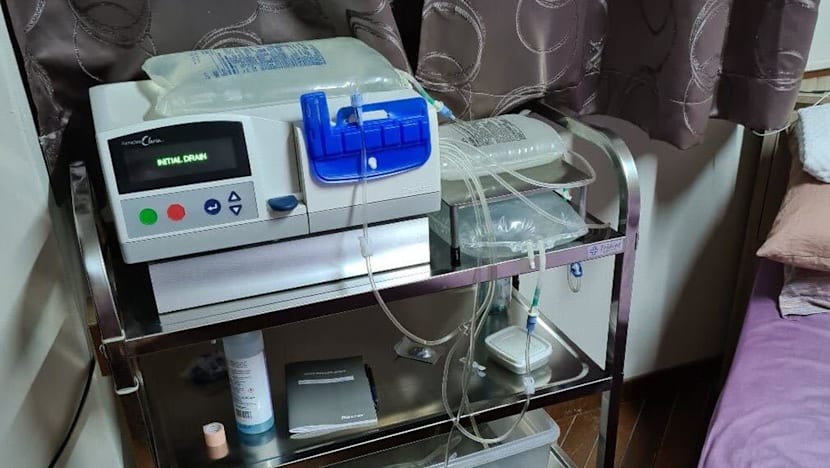
Ms Seng cited strong support from NKF and hospital staff in helping her transition to the home-based treatment.
Inspired by an online overseas community of other patients that she found, she went on to found the local support group, PD Warriors, to help others navigate home dialysis.
She highlighted common misconceptions about the treatment, noting that patients often fear they must maintain a completely sterile home or give up pets – concerns she says can be managed with regular housekeeping.
"There is definitely a lack of awareness. That's why we want to try our best to educate the public about PD and let people know that it's not so scary," said Ms Seng.
Editor's note: A previous version of this article stated that a normal BMI is 18.5. It is actually in the range of 18.5 to 22.9. We apologise for the error.