Crunch time for former Malaysia PM Najib ahead of two crucial court rulings
Malaysia’s High Court will deliver two pivotal rulings in the coming days in the protracted legal battles of jailed former premier Najib Razak.

This audio is generated by an AI tool.


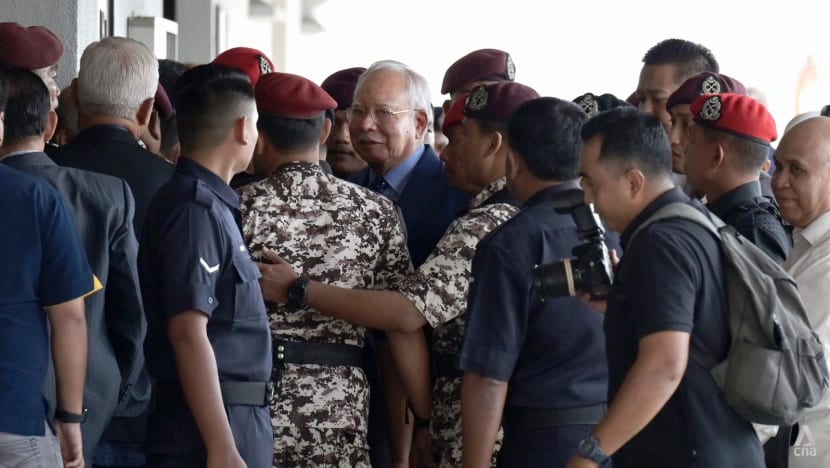
KUALA LUMPUR: Jailed former Malaysia premier Najib Razak’s long-running legal saga will reach a critical juncture next week, with two High Court decisions that could have far-reaching implications for his hopes of a political resurgence.
On Monday (Dec 22), the High Court will rule on whether Najib may serve the remainder of his prison sentence — imposed for his first conviction on abuse of power and money laundering charges linked to state fund 1Malaysia Development Bhd (1MDB) — under house arrest.
A day after Christmas, another High Court judge will rule in a separate trial involving four counts of abuse of power and 21 counts of money laundering over RM2.2 billion in transfers from 1MDB.
The 72-year-old Najib is currently serving a six-year prison sentence in Selangor’s Kajang Prison for the first set of abuse of power and money laundering charges, and lawyers contacted by Â鶹 said the upcoming court rulings may not have any immediate material impact on him.
This is because the verdicts will most likely be subject to potentially lengthy appeals in the courts.
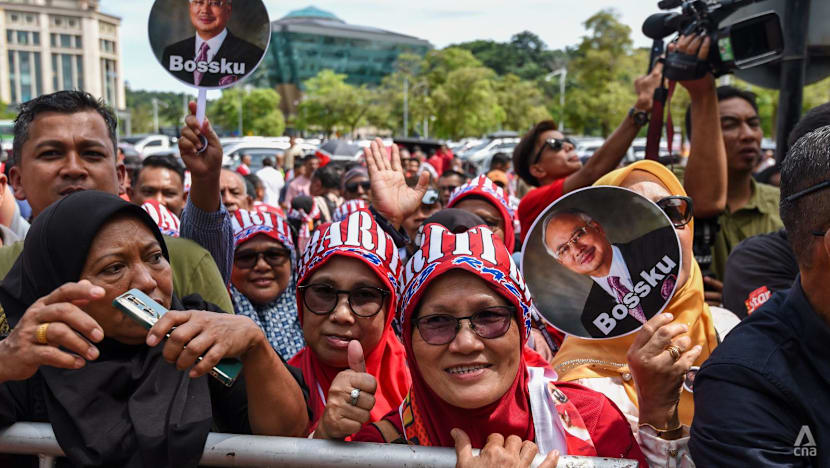
But Najib’s legal trajectory remains closely followed in Malaysia, where the former leader — the son of Malaysia’s second prime minister — continues to polarise public opinion.
His critics view him as the central figure in the 1MDB scandal, a global financial debacle involving the state fund he established in 2009.
But many in the United Malays National Organisation (UMNO), his former party and a current component of Prime Minister Anwar Ibrahim’s coalition, remain sympathetic, along with segments of ethnic Malays.
They believe the state’s prosecution of Najib has been selective and argue that others linked to the 1MDB saga escaped charges after cooperating with investigators.
His supporters also believe a favourable ruling on his house arrest bid would free him from prison confinement and allow him to more actively engage with his allies in UMNO and potentially rejuvenate his political standing.
THE DEC 22 HEARING
This legal confrontation over the house arrest petition stems from a controversial bid by Najib to secure a full royal pardon for his first conviction.
Najib was originally found guilty by a Malaysian High Court in July 2020 on seven charges of criminal breach of trust, abuse of power and money laundering over the misappropriation of RM42 million of funds in state-owned SRC International, a company that was part of the 1MDB web of corporate concerns that were targets of financial embezzlement.


He began serving his prison term only in August 2022 after exhausting appeals to his conviction in the Appeals Court and the Federal Court, the country’s apex judicial body.
The house arrest bid was a secretive gambit first revealed by Â鶹 in an exclusive report in early January last year.
But Najib’s application for a full pardon did not materialise, and ended with clemency from the then-outgoing King Al-Sultan Abdullah Ri’ayatuddin Al-Mustafa Billah Shah, who heads the Pahang royal household.
Najib’s 12-year prison sentence was halved and his fine of RM210 million (US$51.4 million) was reduced to RM50 million. If the fine is not paid, one year will be added to his sentence and his release date will be Aug 23, 2029.
Shortly later, another political curveball appeared. Najib’s legal team insisted that the early February 2024 decision by the Pardons Board – headed by the king – was also accompanied by an addendum order issued by the king that allowed him to serve the remainder of his jail term at home.
Najib’s legal bid for house arrest began in April last year. It has stirred public intrigue because multiple government agencies and members of the Pardons Board for months denied knowledge of a royal document, although the former king’s office confirmed its existence.
In July last year, the High Court had dismissed Najib’s legal bid for the government to produce the addendum order, saying that affidavits supporting Najib's claim were inadmissible as evidence because they were hearsay.
But that ruling was overturned on appeal in a 2-1 split decision by the Court of Appeal in January this year. The Federal Court later upheld the appeal court’s decision, with the Kuala Lumpur High Court ordered to hear the case.
In the High Court, after the twists and turns, Najib’s lawyers argued that the supplementary order was valid, well within the ruler’s discretion and does not require any consultation with members of the Pardons Board.
Prosecutors insisted in court that the so-called addendum was invalid and not enforceable because it was not issued following a decision by the Pardons Board.
A decision on the matter was originally scheduled for Jan 5 but last month, the Kuala Lumpur High Court allowed a request from Najib's lawyers to move the date forward to Dec 22.
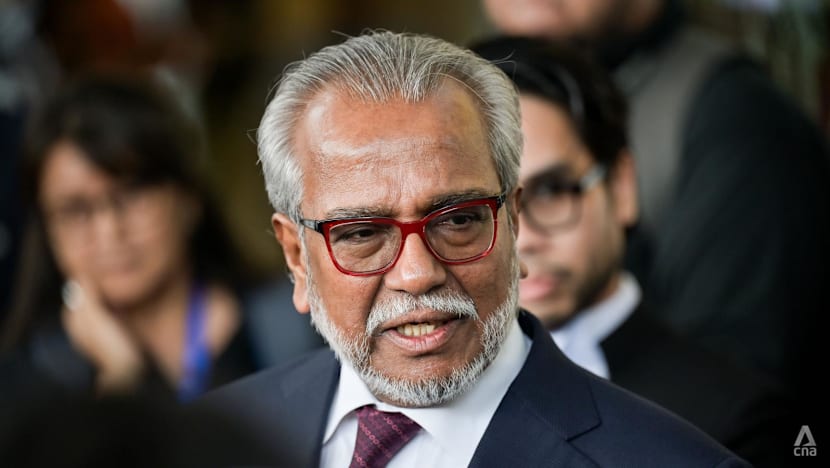
A lawyer who is assisting Najib’s lead counsel Shafee Abdullah said that should Najib be denied his application for house arrest by Justice Alice Loke, the former premier’s defence team will file an appeal against the decision.
The same is expected of the prosecution should the court rule in Najib’s favour.
“I don’t see any major change to the current situation. Even if the court allows house arrest, the prosecution will appeal, which would delay the execution of the order,� said the lawyer.
At a press conference on Thursday, Shafee reportedly argued that should the court grant Najib’s bid, he should be released into house arrest immediately even if the Malaysian government were to appeal.
Appeals will be heard by the Court of Appeal, and its ruling can again still be appealed at the apex Federal Court, meaning that the case could potentially stretch for months, if not years.
Beyond next week’s court ruling, the lawyer assisting Shafee said they are also considering other options, including a bid for a fresh royal pardon.
Najib is midway through his prison term and when asked at Thursday's press conference about the possibility of him seeking parole, Shafee declined to comment. “Parole has not arisen, so I won’t comment more on that,� he said, as reported by Malay Mail.
In Malaysia, a prisoner becomes eligible to apply for parole after serving a minimum of half of a sentence that is at least one year in duration.
THE DEC 26 HEARING
The corruption trial over the misappropriation of RM2.2 billion at 1MDB has dragged on for seven long years and ended only in mid-November this year.
Najib was first charged in 2018 with money laundering and using his position to obtain gratification totalling RM 2.2 billion at an AmIslamic Bank branch. The alleged offences were committed between 2011 and 2014.
The prosecution wrapped up its case on May 30, 2024 and Justice Collin Lawrence Sequerah ruled in October last year that Najib had a case to answer.
Najib’s lawyers had argued that monies that flowed into Najib’s bank accounts were donations he had received from Saudi Arabia and were not funds obtained through illegal means.
“Under all the circumstances, I find that the accused (Najib) was also ‘wilfully blind’ with regard to his failure to inquire into the origin of these funds when the circumstances were such that he ought to have done so,� Justice Sequerah said when ordering the defence to present its case.
Justice Sequerah, who was promoted recently to the Federal Court, said he “found no merit� in claims made by Najib’s lawyer that the charges framed by government prosecutors were defective.
Najib's defence team called a total of 26 witnesses.
Justice Sequerah will deliver his judgment on Dec 26 in the High Court in Kuala Lumpur.
Some observers noted that Najib’s defence team did not present evidence in its representations to the court that was not already introduced or raised during the early stages of the trial.
They also added that whatever the outcome, either side will likely be filing appeals.
“This will very much be the same in both the cases next week,� predicted Zaid Ibrahim, a lawyer and former law minister who has been tracking the Najib cases closely.
If convicted, each abuse of power charge carries a sentence of up to 20 years’ imprisonment and a fine of either five times the amount of the bribe or RM10,000, whichever is higher.
If convicted, each money laundering offence carries up to five years’ imprisonment and a fine of up to RM5 million.
If either side files an appeal, the execution of the court ruling could be delayed pending the outcome of the appeal.