India budget pledges record infrastructure and defence boost
The budget outlines US$133 billion to fund infrastructure and manufacturing capabilities while India receives billions in investments from tech giants.
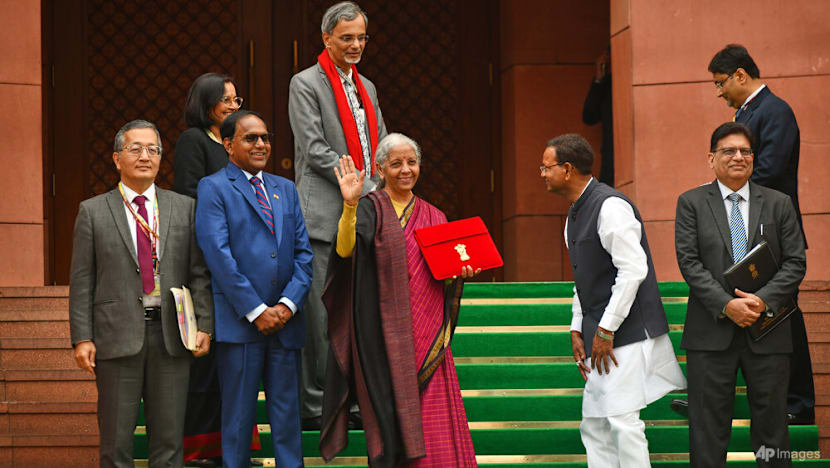
Indian Finance Minister Nirmala Sitharaman, center, displays a red folder containing the Union Budget 2026-27 at the steps of the parliament house before tabling it, in New Delhi, India, Sunday, Feb 1, 2026. (PHOTO: AP)
NEW DELHI: India will spend a record amount on infrastructure and defence, the finance minister said in her national budget speech on Sunday (Feb 1), with plans for high-speed rail, submarines and fighter jets.
New Delhi plans to spend US$133 billion on infrastructure and US$85 billion on defence, a respective rise of around nine and 15 percent compared to last year's budget.\2
Data centres, artificial intelligence, and the mining and processing of rare earths will also receive government support, Finance Minister Nirmala Sitharaman told parliament.
She said public spending on infrastructure had increased dramatically from around US$21 billion (2 trillion rupees) in 2014-15 and that it was now at an "all-time high".
The defence spending hike comes after a four-day conflict with arch-rival Pakistan last May that killed at least 70 people, and saw both sides make extensive use of drones as well as intense missile and artillery barrages.


"BEST INTEREST"
Defence minister Rajnath Singh described the spending as "unprecedented" and said it would help equip India's armed forces with fighter jets, drones, ships, submarines and other critical hardware.
"It is in the best interest of the nation," he added.
New Delhi is in the midst of negotiating defence contracts with domestic and international suppliers, including France, the United States and Germany.
The world's most populous country sees massive infrastructure spending as key to sustaining its high growth rate by boosting domestic manufacturing and creating millions of new jobs.
"India is not content with simply being the fastest-growing economy," Prime Minister Narendra Modi said after the budget.
"India wants to become the world's third-largest economy. This year's budget presents an ambitious roadmap to give new momentum to" domestic manufacturing and self-reliance.
Sectors including textiles, pharmaceuticals, electronics and chemicals are primary targets to boost exports, Sitharaman said.
She promised the development of business parks for textiles and chemicals and said US$5 billion would be spent on boosting domestic electronics manufacturing.
"CONFIDENT STEPS"
It is the first budget since US President Donald Trump imposed 50 percent tariffs on most Indian imports in August.
New Delhi and Washington are in the process of negotiating a long-delayed trade agreement.
But relations have soured over India's purchases of Russian oil, which Washington says is helping bankroll Moscow's war in Ukraine.
New Delhi signed a major trade deal with the European Union last month, with many crediting Trump's tariffs for helping finalise the deal.
"Today, we face an external environment in which trade and multilateralism are imperilled, and access to resources and supply chains are disrupted," Sitharaman said in parliament.
"India will continue to take confident steps towards 'Vikasit Bharat' (developed India) by balancing ambition with inclusion".
The budget touted plans for seven high-speed rail corridors linking some of India's most important cities, including Mumbai, Bengaluru, Hyderabad, Pune, and Chennai.
It also puts forward a scheme to build "rare earth corridors" in four mineral-rich states in southern and eastern India.
Several technology giants such as Amazon, Google and Microsoft, announced investments last year worth billions of dollars in artificial intelligence and data centres across India.
"I propose to provide a tax holiday till 2047 to any foreign company that provides cloud services to customers globally by using data centre services from India," Sitharaman said in her speech.
The government also announced financial support to expand India's recent push to develop its domestic semiconductor industry.