




Commentary: What can ASEAN expect from incoming chair Philippines?
Manila is likely to focus on managing China, but the string of problems it inherits will make its turn as ASEAN chair tricky, says former foreign correspondent Nirmal Ghosh.
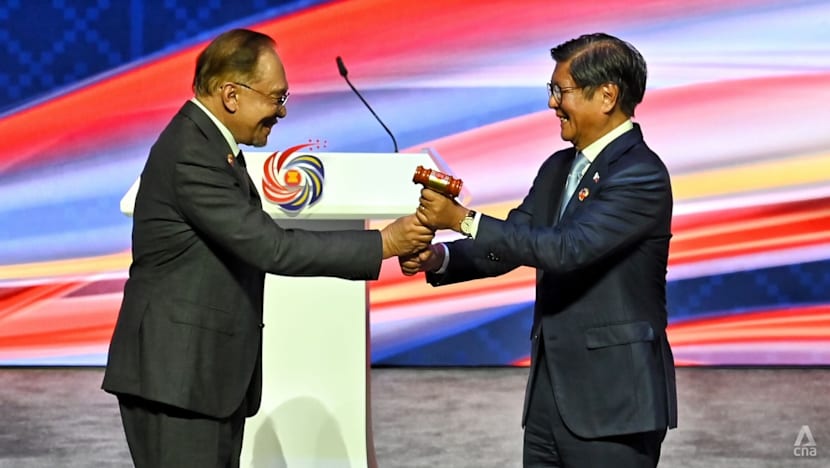
Philippine President Ferdinand Marcos Jr (right) receives the ceremonial gavel from Malaysia Prime Minister Anwar Ibrahim during the closing ceremony of the 47th Association of Southeast Asian Nations (ASEAN) Summit on Oct 28, 2025. The Philippines will chair ASEAN in 2026. (Photo: Â鶹/Zazmahuri Abas)

This audio is generated by an AI tool.


SINGAPORE: On Jan 1, the Philippines takes over the Association of Southeast Nations’ annually rotating chairmanship for 2026 and inherits a menu of problems at a perilous time for the international order – and for ASEAN itself.
But hard issues cloud prospects for real solutions, and there is a risk that much of the action taken will be performative.
The problems include Myanmar’s civil war and an upcoming election there that almost nobody believes will be either free or fair; a conflict between Thailand and Cambodia which may or may not be complicated by an upcoming election in Thailand; and, looming over all of it, the challenge of managing relations with China.
Philippine President Ferdinand "Bongbong" Marcos Jr is himself somewhat hampered as he faces volatility at home amid corruption allegations against him.
TENSIONS IN SOUTH CHINA SEA
The Philippines has a broad agenda: to enhance peace and security; strengthen prosperity and economic ties; and advance people empowerment. But it will have its eyes on one main outcome next year: a code of conduct in the South China Sea.
But that has been under negotiation for around eight years, and whether it will finally emerge remains in doubt. The Philippines certainly has all the incentive to conclude the code of conduct, given its active and edgy disputes with China in the South China Sea.
But these tensions will make China less likely to agree to a code of conduct. Even in the optimistic scenario that the code of conduct materialises, it may end up more symbolic than functional.
The latest clash was on Dec 12 near Sabina Shoal, called Escoda Shoal by the Philippines and Xianbin Reef by China, just 75 nautical miles off the island of Palawan which puts it in the Philippines’ Exclusive Economic Zone. Chinese maritime militia and Coast Guard vessels drove several Filipino fishing vessels out of the area, using high-pressure water cannons that left three Filipinos injured.
The country's chairmanship is in fact likely to be dominated by the question of managing China.

Manila is not friendless on the issue. The US as a formal defence ally recently made a show of strength in November, sailing the Nimitz carrier strike group, joined by Philippine Navy vessels and one Japanese destroyer, near Scarborough Shoal – a major flashpoint with China - as part of a two-day joint patrol and exercises in the South China Sea.
That said, there is an acknowledgement in the Philippines that the US of today is not like the US of previous administrations, says Don McLain Gill, lecturer at the Department of International Studies at Manila’s De La Salle University. The trust deficit President Donald Trump has left with partners and allies will be difficult to repair, he told me.
MARITIME-MAINLAND SPLIT
The Philippines’ turn as ASEAN chair may accentuate a split between maritime and mainland Southeast Asia, with the latter tending to be less vocal than Manila on the question of China.
On the mainland, Myanmar is preoccupied with its civil war, and Thailand and Cambodia are embroiled in a conflict with deep historical roots.
Thailand is heading into an election on Feb 8 that, once settled, may offer a chance for a reset with Cambodia. But hyper nationalism on both sides will ensure that grievances will remain – and Thailand itself may remain stuck in a cycle of fragile revolving door coalition governments.
Myanmar’s election will also solve nothing given the deep and unyielding ethnonational roots of its civil war. The internal conflict in Myanmar has rendered ASEAN a virtual bystander with neither sticks nor carrots to substantially influence the course of events, and it will be left to individual ASEAN members to decide whether to recognise the government that emerges from such an election.
The sole exception is Vietnam, which has its own disputes with China in the maritime domain and would likely be happy to support the Philippines on the South China Sea. But it is also adept at balancing relations and not stepping on the toes of other powers, especially one at its doorstep.
Still, Vietnam is emerging to replace Thailand as a subregional leader, with a GDP is growing at around 8 per cent compared with Thailand’s 2 to 3 per cent.
But with Laos mired in debt, Cambodia in a state of conflict, Thailand in economic doldrums, and the scam industry and associated criminal activity undermining the region, there is the risk of deepening chronic instability in the heart of mainland ASEAN.
EARNING ASEAN CENTRALITY
This comes at a time when ASEAN needs to enhance its own internal integration and gear up to – as Malaysia’s Prime Minister Anwar Ibrahim and Singapore’s Prime Minister Lawrence Wong have put it – earn its treasured centrality.
One measure of that centrality is that major leaders, particularly the president of the United States, show up during the bloc’s season of summitry (though Mr Trump may be too preoccupied with critical midterm elections to make the trip in 2026).
Mr Marcos, in remarks in Kuala Lumpur in October at the handover of the chairmanship, noted that while change may be unpredictable, “our compass must remain constant, anchored in cooperation… (and) oriented toward maintaining a stable and secure region, built upon a shared vision of an open, inclusive, transparent, and rules-based ASEAN regional architecture.”
Some nuts-and-bolts deliverables may emerge from the Philippines’ chairmanship, including greater economic integration and more steps towards a common market, and enhanced disaster preparedness and humanitarian assistance. The Philippines may also seek to formalise a currently informal ASEAN Coast Guard forum to contribute to maritime domain awareness.
But in geostrategic terms, ASEAN’s international reputation has never been lower since the (1997) Asian financial crisis, Singapore’s famously straightforward former diplomat Bilahari Kausikan told me.
“It is going to be harder to recover the reputation this time,” he said. “The strategic environment has changed dramatically, but ASEAN has not.”
Mr Marcos’ choice of words left little doubt that he is well aware of what ASEAN is up against. But the Philippines has little leverage and bandwidth to manage the problems it will inherit – plus the integration of ASEAN's 11th member Timor Leste.
The best that Manila may hope for, may be to steer a steady course through what promises to be another year of churn, not least because of the still evolving strategic priorities of its own principal defence ally, the United States, while ensuring ASEAN does not fragment and US-China rivalry in the region does not combust.
Nirmal Ghosh, a former foreign correspondent, is an author and independent writer based in Singapore. He writes a monthly column for Â鶹, published every third Friday.



