




Motorcyclists blame ERP 2.0 unit for battery drain; LTA and workshops point to other causes
The Land Transport Authority says it has received about 60 reports from motorcyclists about battery issues since they installed ERP 2.0 units.
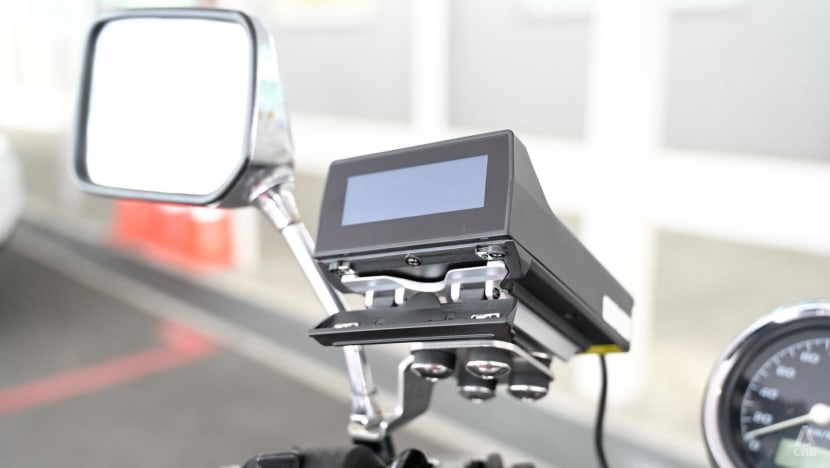
For motorcycles, the OBU components - a processing unit, an antenna and a touchscreen display - are integrated into a single unit. (Photo: Â鶹/Hanidah Amin)

This audio is generated by an AI tool.


SINGAPORE: More than a year after motorcycles began transitioning to the ERP 2.0 system, some riders have raised concerns that the new on-board units (OBUs) are draining their batteries faster than the previous devices.
Several motorcyclists told Â鶹 their batteries appeared to discharge more quickly after installing the OBU, particularly when their bikes sat unused for several days. The complaints have also surfaced on online forums.
However, the Land Transport Authority (LTA) and motorcycle workshops say the issue is unlikely to be caused by the OBU itself, pointing instead to ageing batteries and underlying electrical problems.
The new OBUs are designed for Singapore's new satellite-based ERP 2.0 system. Motorcyclists began switching from the old in-vehicle units (IUs) in June last year, with all vehicles required to install the new system by the end of 2026.
As of October, more than 146,000 motorcycles – around 97 per cent – have had OBUs installed, according to LTA. The authority said it has received about 60 feedback cases related to OBUs draining motorcycle batteries.
RIDERS REPORT FASTER BATTERY DRAIN
Ms Jane Ye, who rides a six-year-old Yamaha, said her battery previously drained after a week of inactivity with the old IU. After installing the OBU earlier this year, she noticed the battery draining after just a few days without riding.
"Before the OBU, the old IU only drained my battery once in the more than five years I was riding," said the administrative manager, whose battery drained twice in the months following installation.
Mr Tommy Lee, 57, director of adventure biking firm Route 55 Adventures, said his motorcycle battery weakened noticeably after 40 days without use.
"The cranking of the engine when first starting is not instantaneous, and it's a sign the battery is weak," he said. "I have left my bike for a long time before, one to two months at times, and (there was) no problem with the previous IU."

POWER DRAW LOWER THAN PREVIOUS SYSTEM: LTA
LTA said the OBU is designed to draw minimal current even when the motorcycle is off, and that this power draw is actually lower than the previous IU.
Like the old IU, the OBU requires continuous power to operate. According to LTA's One Motoring website, when a vehicle's ignition is turned off, the OBU enters sleep mode and draws even less power than the IU did.
A spokesperson said that OBUs function as mini-computers that continually send and receive information such as traffic updates, requiring a continuous power supply to operate reliably and maintain performance.
"Motorcycle battery issues are unlikely to be linked to the OBU installed," the spokesperson said. "In such cases, it is likely that the motorcycles have a weak or old battery."
Motorcycle workshops echoed LTA's assessment, pointing to various factors beyond the OBU that could cause battery drainage.
Mr Willian Tan, director of THCycle Motorcycle Repair and Servicing Workshop, said the OBU will not drain a motorcycle's battery unless it has been tampered with. Unlike the previous IU, which had only two wires connected to battery terminals, the OBU has three wires connected to both the battery terminals and the ignition.
Mr Tan said the OBU has its own battery. "We connect to the battery because we need support for that small battery in the OBU, and the extra wire to the ignition – when you start up the bike then it supplies current to the OBU."
He added that battery problems may stem from improper wiring causing current leakage. Modern batteries also have a shorter lifespan than older models, Mr Tan said, and riders could be experiencing issues as batteries reach their lifespan.
Ms Nur Shakila of specialist workshop Ban Hock Hin said it has received fewer than 40 battery drainage cases since OBU installation began. The OBU uses only a very small amount of current in sleep mode compared to the IU, she said, and should not cause a healthy battery to discharge under normal circumstances.
"In most situations, battery performance and power stability are influenced not only by the battery’s age and condition, but also by the overall health of the motorcycle’s electrical system," she said.
"Some motorcycles, while still able to start, may have underlying issues such as weak rectifiers, faulty magnetic coils or other electrical components that affect charging efficiency."
Ms Rebecca Lim, an assistant at Zack Enterprise, said the workshop sees almost the same number of battery-related cases with the OBU as it did with the IU. She noted that OBUs may be more prone to damage when motorcycles are parked in unsheltered areas exposed to sun and rain.
RECOMMENDATIONS FOR RIDERS
Workshops typically check battery health when installing the OBU and recommend replacement where necessary.
For motorcycles left unused for extended periods, Ms Shakila recommended that riders use their motorcycles periodically for about 10 minutes every two weeks, or use a smart battery charger during prolonged periods of inactivity.
"We strongly recommend that the OBU be connected to a continuous power supply to avoid affecting (its) proper functioning and lifespan," she said.
Workshops cautioned against rewiring OBUs or disconnecting any wires, as this could disrupt or damage the device.
Editor's note: An earlier version of this article said all vehicles are required to install the new OBU by the end of this year. That is incorrect. The initial deadline was extended to the end of 2026.


